Graphic Designer & Illustrator
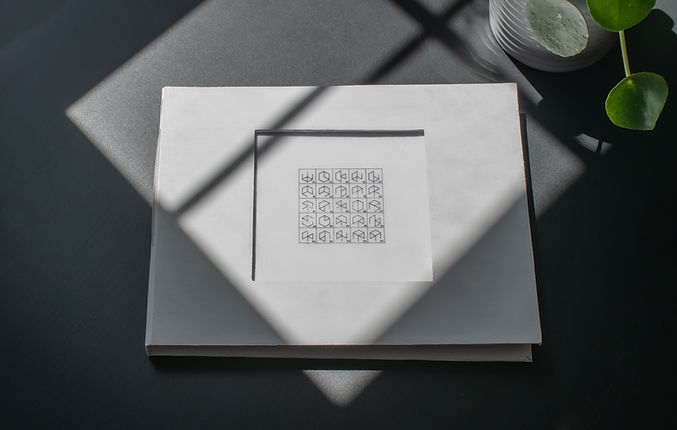
Sol LeWitt Artist Book
Mixed Media, InDesign, 2019
Digital Media Production
For the final project in my Digital Media Production class, we were tasked with designing and building an artist book for an artist of our choice. An artist book is a medium that uses the form or function of "book" as inspiration. The final, fully assembled book needed to reflect the artist and thier work in both the construction, design, and fold.
To learn what artist books looked like and how they functioned, we visited the university library. There we met with one of the librarians who gave us a tour of some of the artist books in the university collection. This hands-on experience gave us an insight into the wide variety of styles artists could use when creating an artist book. Though this experience helped define what exactly we were building, the wide array of designs and styles was overwhelming.
The scope of the project would require a lot of research and planning. I would need to prototype throughout the design process and print regularly.
Sol LeWitt:
Incomplete Open Cubes
I started researching my artist, Sol LeWitt, both online and in the university library. I was focused on looking for two things: text and images. I first started looking for basic information on LeWitt and a variety of large-format images. LeWitt had a long and successful career spanning decades. His work through those decades varied in medium and style. I had too much information and images to use. I needed to narrow my research into something more specific. I decided to focus on a single series of works to use in the artist book.
I settled on Sol LeWitt's Incomplete Open Cube series. It is a body of work I enjoyed studying during my freshman year in 3d design class. With a specific body of work in mind, I quickly found an article online reviewing the series of works, "Art Machine by Jonathan Flatley. I now had text to fill my artist book with and images to use.


Making the 1st Prototype
Mixed Media
My first prototype was extremely rough. I decided to make the book in an accordion fold. In galleries, LeWitt's work is often organized in large groups. For example, when Incomplete Open Cubes is shown, all of the sculptures are shown in one large group. I wanted the reader to have a similar experience by being able to complete open the book and view it all at once.
I printed all the images I planned on using on a very small scale. Using copy paper, I folded the pages of the book. I taped the small images inside to start planning how I could organize how each spread. I used a pencil to mark areas where text boxes could be placed.
The Flatley article focuses on the dichotomy between presenting LeWitt’s three-dimensional work with his two-dimensional work. The design of my artist book needed to reflect this theme. When planning the layout of images in my design for my first small-scale prototype, I realized that I could make LeWitt's sketches pop-ups. The sketches were drawings that showed the cubes in almost perfect 45-degree angles. By placing the sketches in the seam of the book and cutting out the foreground, I could make the 2D images into 3D pop-ups. I also thought it would be interesting to create these pop-ups of the 2D sketches next to the 2D images of LeWitt's 3D sculptures.
Because LeWitt's sketches were made on vellum, I wanted to include vellum as a material in the design. In my first prototype, I used vellum as the first and last pages of the artist book with a LeWitt sketch printed on it. I also planned on cutting a hole in the cover to reveal a printed sketch on the vellum inside.
Making a 1:1 Scale Prototype
Mixed Media
After layout my text and images in InDesign, I printed and assembled another prototype. This prototype was printed at a 1:1 scale of the final piece. I wanted to ensure that the design of my text looked good printed to scale and that my images were printed to scale without pixelation.
I wanted my design to reflect the time in which the artwork was created. To do so, I found a font used when the artwork was created, Twentieth Century.
At this stage, I was also able to test the pop-up effect. It worked well at this scale, but I wanted the book to reflect LeWitt's work more than just with pop-ups. I decided at this stage I would cover my final book in a wood material painted white to mimic the white painted wood LeWitt used in his sculptures. I wanted to keep the cut out on the cover, but I was not entirely sure I would be able to cut a hole in wood precisely enough to use as the cover.


Final Prototype
Mixed Media
Binding the final book was much harder than I had anticipated. Thus far, all of the prototypes I had created were printed on copy paper. Copy paper is extremely thin an easy to fold. This final version of the artiast book was printed on a higher quality paper with a heavier weight. Because I had designed several full-bleed images in multiple spreads, I need to be careful when creasing the paper as I folded. I also needed to be precise in my folding in order for the 3D pop-ups to function properly.
Once the accordian insert was assembled and folded, I printed all of the LeWitt sketches on vellum. I glued the printed vellum into the design and folded the vellum sleeeve to ccover the accordian folded instert with. I used a needle and thread to join the accordian inset and velum sleeve. I had to add a thin piece of paper on the spine to keep from tearing the vellum as I sewed. I then turned my attntion to the cover.
I used a thin balsa wood sheet I painted white for the cover of the artist book. The thin material allowed me to easily cut out the center to reveal the vellum inside. It also added a tactile element for the reader to experience as they opened the book. I then glued the insert into the cover.

The Results
Mixed Media
The Result
...